Single Photonic Chip Generates, Routes, and Reads Light—A Leap Toward Ultra-Fast Computing
For decades, the semiconductor industry pushed silicon to do more and more with less and less space. Now, a chip the size of a fingernail suggests the next breakthrough may not come from squeezing more transistors into smaller spaces, but from replacing electrons with photons.
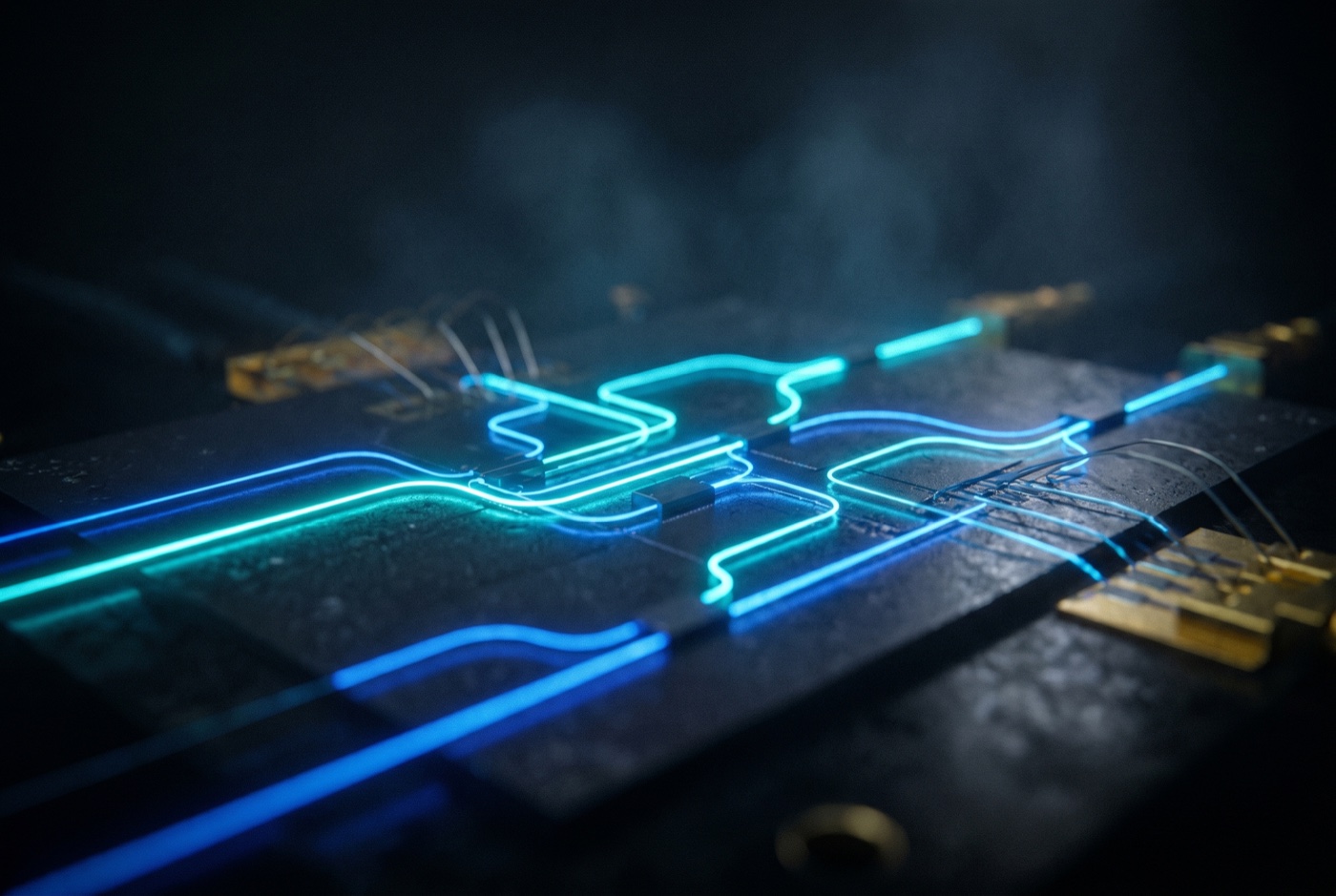
Researchers at Monash University in Australia have demonstrated a device capable of doing three things that previously required separate components: generating, routing, and reading information encoded in light, all within a single integrated chip. The work, published in Nature Photonics, marks a tangible milestone in photonic computing—the research field attempting to replace portions of electron-based data movement with photons.
What Was Done
The difference lies in integration. It was already possible to produce specialized optical signals in laboratories. It was already possible to detect them. What was missing was a single system that could create the signal, guide it along a defined path within the chip itself, and convert it back into an electrical signal without jumping between separate devices. This complete, end-to-end circuit is what the team demonstrated.
To accomplish this, the team used atomic-scale materials and nanometer-scale structures to manipulate a quantum property of light known as "valley." This is the field of valleytronics, where information is encoded in ways that conventional transistors cannot access. According to the researchers, the result is an on-chip system capable of creating, routing, and reading this type of information with high precision. To be clear: this is research, not off-the-shelf product. There is no chip here ready to enter a data center tomorrow.
Why It Matters In 2026
The context explains the measured enthusiasm. Silicon's bottleneck is not merely about speed; it is thermal and about data movement. Moving bits between memory and processor consumes energy and generates heat, and that heat imposes a physical ceiling. Photonics attacks both of these points directly: light travels fast, with less loss due to heating and with lower energy cost to transport data over distance.
This detail has ceased being academic in 2026. The cost of training and, especially, of serving AI models at scale has become a budget line item and an infrastructure question. Data centers compete for power and cooling as critical resources. When computational performance climbs along the same curve as the electricity bill, the constraint shifts from technical to economic. It is at this point that photonic architectures become compelling: the promise is not only to go faster, but to decouple part of the performance gain from proportional growth in power consumption.
There is a second dimension: quantum. Controlling properties like the "valley" of light opens pathways to information systems that are not only faster, but qualitatively different. For now, this is mapped potential, not delivered capability.
What This Changes For Enterprises
For those who make technology decisions in Brazil, the right reading is one of direction, not timeline. No company will buy a photonic server this year because of this announcement. What changes is the direction of the arrow. Computational energy cost is becoming a strategic variable, and anyone planning AI infrastructure for the coming years does well to treat energy efficiency as a design criterion, not a footnote.
In the near term, real gains continue to come from mundane decisions within your control: choosing the right model for each task instead of the largest available one, sizing inference with sobriety, measuring consumption and latency with the same rigor you apply to accuracy. Photonics is the long-term argument for believing that this efficiency work will not be in vain, because hardware is moving in the same direction.
10Dobro Prod Takes
In our thesis, AI doesn't replace teams; it multiplies what good teams already deliver. Hardware that does more with less energy follows the same logic applied to machines: the goal was never to spend more to achieve more, but to break the proportion between the two. A chip that generates, routes, and reads light within the same physical form is, at bottom, a bet on density—fitting more capacity into the same physical and energy envelope.
We follow these developments with our feet on the ground. Integrated photonics is still research, and our commitment is not to sell the future as the present. But the strategic reading is clear: the energy bill for AI has stopped being a problem only for chip manufacturers and has become a problem for those who operate, train, and serve models, which includes much of Brazil's corporate base now assembling their first AI pipelines.
The takeaway is direct. The Monash chip does not speed up your operation tomorrow, but it confirms where the physical ceiling of computing is moving. Those who treat energy efficiency as an engineering decision today will be on the right side of the curve when this hardware leaves the laboratory. Sources: ScienceDaily (sciencedaily.com/releases/2026/06/260601025343.htm), Nature Photonics, and Monash University.
Got an AI, video, or growth project?
Talk to us →