Cryogenic Neuromorphic Chip and Distributed Quantum Computing Attack the Scaling Limit
Quantum computing has spent the last decade trapped by the same bottleneck: qubits alone are not enough. You need many qubits, and you need to keep them stable enough to perform actual computation. In June 2026, two announcements from entirely different sources attacked this limit from opposite flanks, and together they offer clearer sight into the path from laboratory toward utility.
What Happened
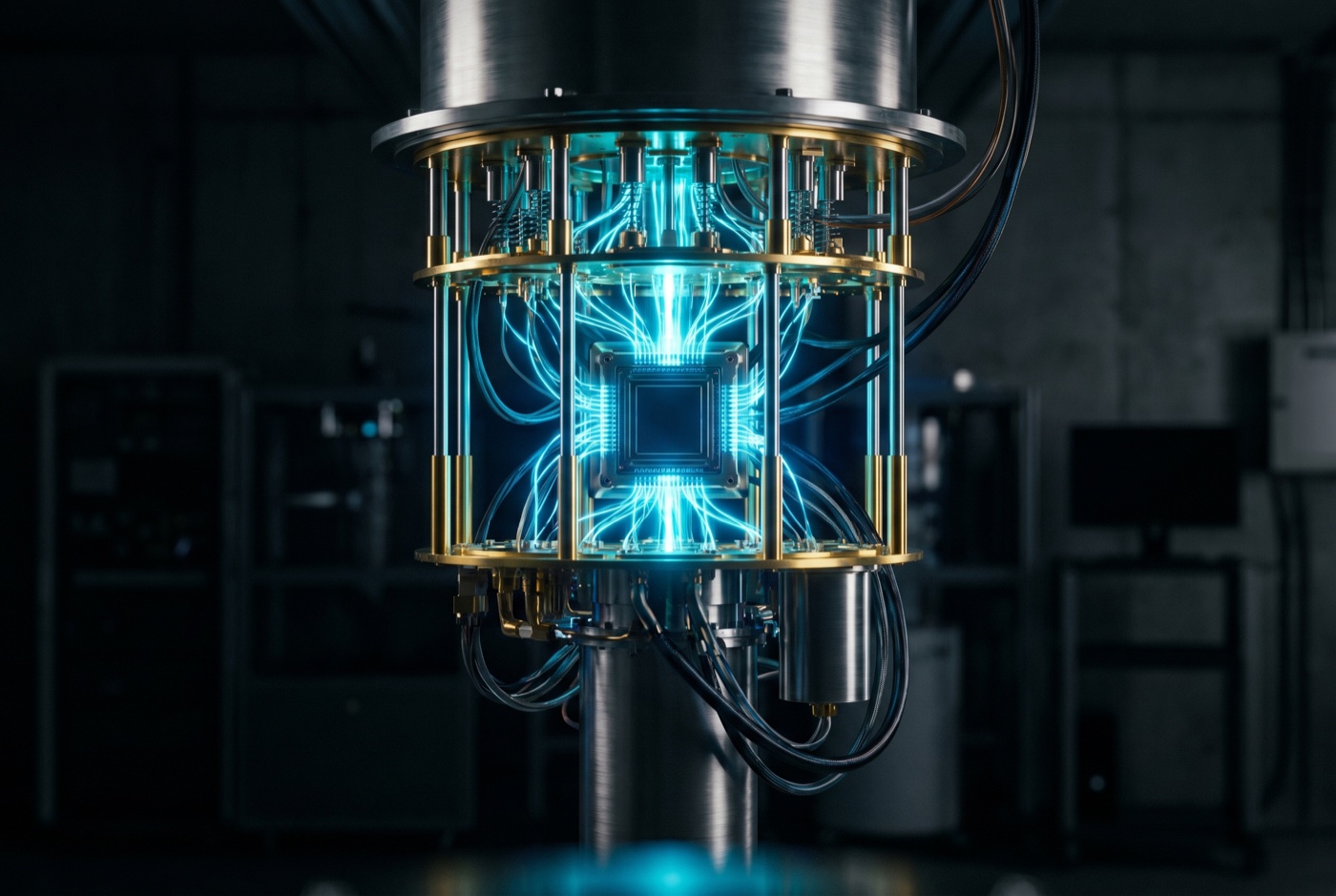
The first came from the University of Hong Kong (HKU). The engineering team demonstrated a cryogenic neuromorphic chip built with silicon carbide (SiC) power transistors—standard industrial-grade components—capable of operating at 10 millikelvin, the same temperature range where superconducting qubits live. The discovery, published in Nature Communications, rests on a curious physical property: when cooled below 2 kelvin, these SiC transistors exhibit stable negative differential resistance. By modulating gate voltage, researchers can control charge-carrier dynamics in the material and trigger the transistor to fire like a biological neuron, emitting pulses. The mechanism is called EDII (electron donor impact ionization), and the analogy to neural firing is not metaphor—it is the precise property that opens a path to local processing alongside the qubits.
Why does this matter? Because heat and wiring are the silent enemies of scale. Today, controlling each qubit demands cables that run from the warm world down to the frozen heart of the machine. More qubits means more cables, and each cable brings noise and heat into the system. A chip that thinks and decides right there, at the qubit's own temperature, promises to eliminate thousands of connections and reduce thermal load. This is platform engineering, not spectacle.
The second announcement is of a different character. Atom Computing, based in the United States, and Nu Quantum, based in the United Kingdom, signed a memorandum of understanding on June 17 to pursue distributed quantum computing. Instead of stacking everything into a single monolithic processor, the bet is to interconnect multiple neutral-atom machines via reconfigurable photonic network hardware, forming clusters. The work focuses on integrated optical switches, on technologies for entanglement between qubit and photon, and on modeling distributed fault-tolerant architectures. The stated target is ambitious and specific: reach the GigaQuOp threshold—that is, one billion quantum operations—by working around the physical limits of space and control that constrain the single chip.
Why This Matters in 2026
Both moves share a diagnosis. Quantum computing no longer hits an abstract wall; it hits concrete engineering problems—wiring, heat dissipation, interconnection. Attacking scale from inside the cryostat (HKU) and from outside, by networking machines together (Atom + Nu Quantum), are complementary answers to the same impasse. One reduces friction inside the refrigerator; the other dissolves the boundary of a single chip. When the conversation in a frontier discipline shifts from theoretical physics to cable management and network architecture, it is a sign of maturation. It is the moment when research starts to become product.
Implications for Decision Makers
For the business leader, the reading must be sober. None of these announcements puts a useful quantum computer into your operations in 2026. What they do is shorten the timeline to the three applications that genuinely matter for enterprise: simulation of materials and molecules (chemistry, energy, agriculture), cryptography (and its defensive counterpart, migration to post-quantum standards), and optimization of large-scale problems—routes, allocation, portfolios. These are precisely the pain points that weigh on the national productive and logistics sectors.
The practical recommendation is about posture, not checks. No company outside the major labs needs to buy quantum hardware now. What makes sense is to map where optimization or simulation stalls your business today, formulate those problems clearly, and track the cryptography risk calendar—because the post-quantum transition is the only one of these fronts with a timeline already in motion. Companies that arrive in the quantum era with poorly formulated problems will waste the technology when it matures.
The 10Dobro Prod Angle
At 10Dobro Prod, we read these advances through the same lens we apply to AI: frontier technology doesn't replace teams; it multiplies what a good team already delivers. A neuromorphic chip at 10 millikelvin only pays off if there is clarity about which problem you want to solve. The rule holds for quantum computing and holds today for automation and data—frontiers where multiplication is already real and applicable.
Our thesis is measured, in the medium term, unhurried and free of hype. Quantum computing remains a patient wager, and treating it as an immediate solution would be the same error we combat everywhere else in the market. But each engineering advance like these two narrows the gap between promise and practice.
The takeaway is direct: quantum computing stopped being a physics problem and became a problem of engineering scale. When a frontier changes nature like this, it stops being fiction and starts having a timeline. It is not your timeline yet. But it is time to know where, in your operation, this machine would fit.
Got an AI, video, or growth project?
Talk to us →